

Has your child been turning up the TV volume lately? Not responding when you call their name? These could be signs of fluid trapped in the middle ear—a common problem that affects 8 out of 10 children before age 10.
The good news? Fluid in the ear is usually not serious and often clears up on its own. But if left untreated, it can lead to hearing problems and speech delays. Here’s everything parents in Dubai need to know about detecting and treating this condition.
What Is Fluid in the Middle Ear?
Fluid in the middle ear (doctors call it “otitis media with effusion” or OME) happens when thick, sticky fluid builds up behind the eardrum. Unlike a regular ear infection, there’s usually no pain or fever.
Think of it like this: the middle ear is a tiny air-filled space. When fluid fills this space instead of air, sound can’t travel properly—making everything sound muffled to your child.
Why Children Get It More Than Adults
Children are more prone to ear fluid because of a small tube called the Eustachian tube. This tube connects the middle ear to the back of the throat and helps drain fluid.
In children, this tube is:
- Shorter than in adults
- More horizontal (doesn’t drain as well)
- Narrower (blocks more easily)
This is why ear problems are so common in kids under 5 years old.
Warning Signs Your Child May Have Fluid in Their Ear
Fluid in the ear often has no obvious symptoms. Your child probably won’t complain of pain. But watch for these signs:
At Home
- Turning up the TV or tablet volume higher than usual
- Not responding when you call their name
- Asking “what?” frequently
- Tugging or pulling at their ears
- Trouble sleeping or increased fussiness
Speech and Development
- Speaking later than other children their age
- Difficulty pronouncing certain sounds
- Falling behind at school or nursery
Medical History
- Recent cold or upper respiratory infection
- Previous ear infections
- Snoring at night
- Enlarged adenoids
Important: If your child shows any of these signs for more than a few weeks, it’s worth getting their ears checked by a pediatrician in Dubai.
How Doctors Detect Fluid in the Ear
There are two main tools doctors use to check for ear fluid:
1. Otoscope (Basic Ear Check)
An otoscope is a small handheld device with a light. The doctor looks into your child’s ear to see the eardrum. If the eardrum looks dull, cloudy, or isn’t moving properly, fluid might be present.
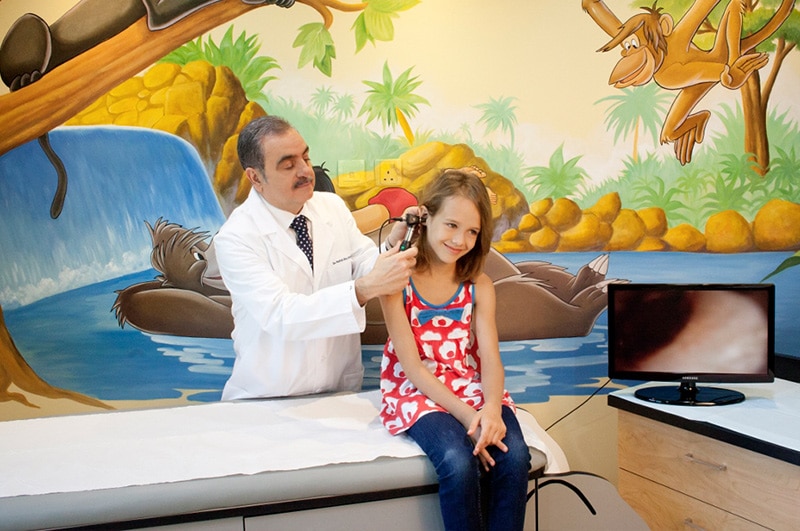
At myPediaclinic, we use a video otoscope—this displays a magnified image on a screen so you can see exactly what the doctor sees. Children often find this fascinating rather than scary!
2. Tympanometry (The Gold Standard)
Tympanometry is the most accurate way to detect fluid in the middle ear. Here’s what parents should know:
What happens during the test:
- A small, soft rubber tip is placed in your child’s ear
- The device sends gentle air pressure and a quiet sound
- It measures how the eardrum responds
- The whole test takes just a few seconds
Does it hurt? No. Tympanometry is completely painless. Your child might feel a slight pressure (like being in an elevator), but there’s no discomfort.
How accurate is it? Studies show tympanometry is over 80% accurate in detecting middle ear fluid—much more reliable than a visual exam alone.
Good to know: Not all clinics in Dubai have a tympanometer. At myPediaclinic, we have this equipment available for accurate diagnosis.
Treatment Options in Dubai
The treatment depends on how long the fluid has been present and whether it’s affecting your child’s hearing.
Watchful Waiting (Most Common)
In most cases, doctors recommend waiting 2-3 months. Why? Because 75-90% of ear fluid cases clear up on their own without any treatment.
During this time:
- Avoid smoking around your child (secondhand smoke makes it worse)
- Keep up with regular check-ups to monitor progress
- Make sure your child stays well-hydrated
Medication
Antibiotics are not usually needed for fluid in the ear (it’s not an infection). However, your doctor may recommend:
- Nasal sprays to reduce inflammation
- Antihistamines if allergies are a factor
Ear Tubes (Grommets)
If fluid persists for more than 3 months and is causing significant hearing loss, your doctor may recommend ear tubes. This is a simple procedure where tiny tubes are placed in the eardrum to help fluid drain.
Ear tubes are very common—they’re one of the most frequently performed procedures in children worldwide.
When to See a Pediatrician in Dubai
Book an appointment if your child:
- Shows signs of hearing difficulty for more than 2-3 weeks
- Has had multiple ear infections in the past year
- Is showing speech or language delays
- Has fluid that hasn’t cleared after 3 months
Seek immediate care if:
- Your child has severe ear pain
- There’s discharge or bleeding from the ear
- Your child has a high fever with ear symptoms
- You notice sudden hearing loss
Preventing Ear Fluid Problems
While you can’t prevent all cases, these tips can help reduce your child’s risk:
- Breastfeed if possible — Studies show breastfed babies have fewer ear problems
- Avoid bottle-feeding while lying flat — This can cause fluid to flow into the ear
- Keep your child away from cigarette smoke
- Stay up to date on vaccinations — Especially flu and pneumococcal vaccines
- Wash hands frequently — To prevent colds that can lead to ear fluid
Expert Ear Care at myPediaclinic Dubai
At myPediaclinic in Dubai Healthcare City, we understand how worrying ear problems can be for parents. Our team includes experienced pediatricians who specialize in childhood ear conditions.
What we offer:
- Tympanometry testing for accurate fluid detection
- Video otoscopy so you can see your child’s ear health
- Child-friendly environment to keep little ones calm
- Same-day appointments available
If you’re concerned about your child’s hearing or suspect ear fluid, book an appointment with our pediatric team today.
Frequently Asked Questions
How long does fluid in a child’s ear last?
Most cases of ear fluid clear up on their own within 4-6 weeks. If fluid persists for more than 3 months, your doctor may recommend treatment options like ear tubes.
Can fluid in the ear cause permanent hearing loss?
Temporary hearing loss is common with ear fluid, but permanent damage is rare. However, prolonged fluid (more than 3 months) during early childhood can affect speech and language development if not treated.
Is tympanometry safe for babies?
Yes, tympanometry is completely safe and painless for children of all ages. For babies under 4 months, doctors may use a different frequency setting for more accurate results.
How much does ear fluid treatment cost in Dubai?
A consultation with a pediatrician in Dubai typically ranges from AED 300-600. Tympanometry testing is often included or available at minimal additional cost. Most insurance plans cover these services.
Can I treat my child’s ear fluid at home?
While waiting for fluid to clear naturally, keep your child well-hydrated, avoid secondhand smoke, and don’t insert anything into the ear. However, you cannot treat ear fluid at home—always consult a pediatrician for proper diagnosis.